Wodlands & Trees Outside Woods
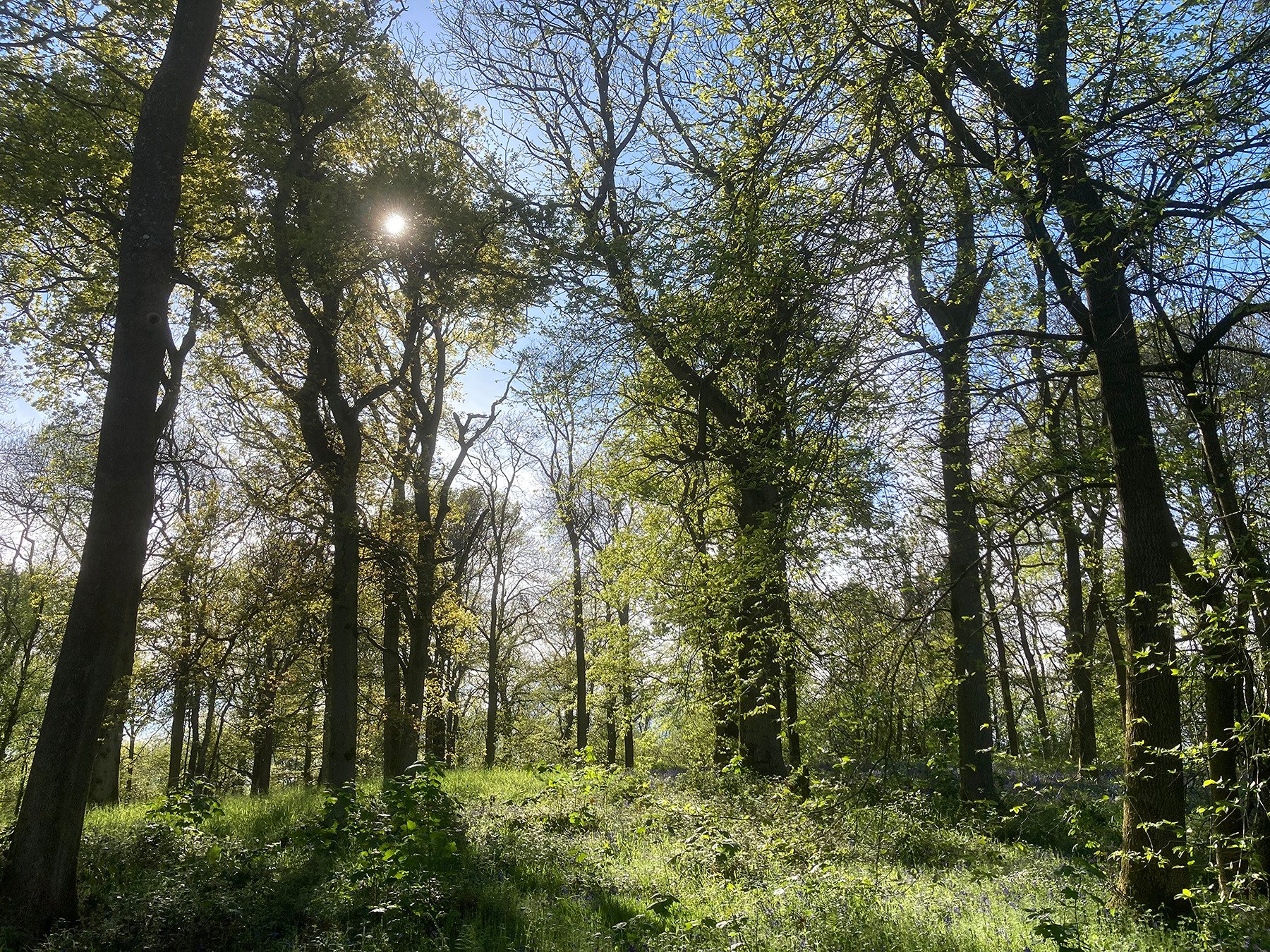
Woodlands
According to the Office for National Statistics, Herefordshire woodlands covers about 12% of its land area. This is slightly more than the 10% of England that is wooded but slightly less than the
The UK has an area of 243,610 square kilometres of which about 13% is covered by woodland. England is about 10% wooded while Herefordshire sits between these, with 12% of its land area under woodland, amounting to about 262 square kilometres.
Woodlands in the UK can be classifies into various types, most of which are represented within the county. Primarily these are:
Broadleaved Woodland: Composed predominantly of native deciduous trees, representing some of the most biodiverse environments in the UK &
Coniferous Woodland: Dominated by conifers, often in managed plantations.
Also found in the county are Wet Woodlands, which have developed on poorly drained soils, such as in river valleys or around bog fringes, often featuring alder, willow, and birch while there are also fine examples of Wood Pasture and Parkland, which form a mosaic habitat with trees and shrubs (often including veteran and ancient trees) in a grassland setting, traditionally managed through a combination of grazing and timber production.
Woodlands are also classified based on their history, management, and composition, classifications that help to determine conservation priorities and restoration efforts. The key Woodland Classifications are as follows:
Ancient Woodland (AW): Land that has been continuously wooded since at least 1600 AD (1750 in Scotland). It is considered an irreplaceable habitat.
ASNW (Ancient Semi-Natural Woodland): Ancient woodland that retains a high proportion of native tree and shrub species that have regenerated naturally, rather than being planted.
PAWS (Plantations on Ancient Woodland Sites): Ancient woodland sites that were felled and replanted, typically in the 20th century, with non-native conifers or other non-native species. Although their ecological value was degraded, they often retain vital remnant features, such as ancient soils, ground flora (e.g., bluebells), and fungi, making them high priorities for restoration.
RNWAS (Restored Native Woodland on Ancient Sites): Former PAWS sites that are being or have been actively restored to native woodland, often through the removal of conifers and the encouragement of natural regeneration.
Secondary Woodland: Woodland that has developed on land that was previously cleared of trees (e.g., former farmland or industrial land). It is generally more recent in origin and often species-poor compared to ancient woodland.
The restoration of PAWS involves the long-term, gradual removal of non-native trees to allow the original native woodland to recover. Methods include:
Continuous Cover Forestry (CCF): Managing forests without clear-felling.
Low Impact Silvicultural Systems (LISS): Techniques used to minimize damage to soils and wildlife during restoration.
Conservation Grazing: Using livestock to manage vegetation in former PAWS sites.
A more detailed discussion of these woodland types, touching on woodland succession and regeneration with descriptions of the identifying features of semi-natural woodland types is provided in an extract from a publication available HERE - Managing your Woodland for Wildlife by David Blakeley & Peter Buckley. While I would question some of the concepts set out (notably that of 'climax' ecosystem, as well as the omission of any consideration of the the work of Franz Vera - see HERE) there is much helpful information about the classification and identification of woodland types.
However, the most detailed classification of woodland type is the National Vegetation Classification: Field Guide to Woodland. Published in 1991 and based on 2,648 samples from ancient and recent woods throughout Britain, it defines 18 main woodland types and seven ‘scrubs or underscrubs’, most of which are divided further to give a total of 73 sub-communities. Invaluable to ecologists, NVC does perhaps provide rather more fine detail than the non-specialist is likely to easily accommodate!
Trees outside woodland
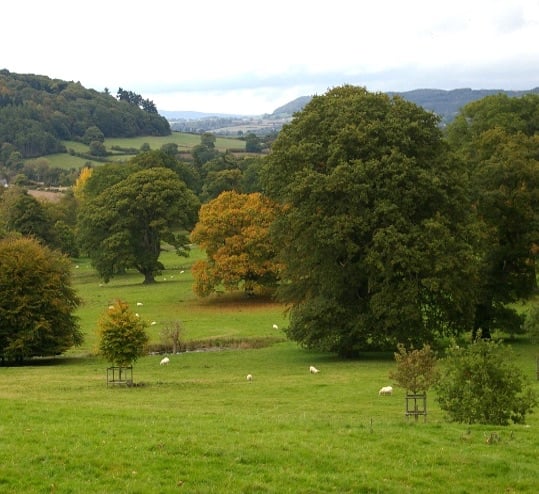
Trees outside woodland: The Hidden Forest
When people think about forests in the UK, they often picture large woodland areas such as Sherwood Forest or The New Forest. Yet millions of trees grow outside these traditional woodlands—along roads, in farmland, parks, hedgerows, gardens, and urban spaces. These Trees Outside Woodlands (TOW) may be individual trees or small groups of trees located beyond formally mapped woodland areas and they form a vast but often overlooked network of green infrastructure that plays a crucial role in biodiversity, climate resilience, and everyday life across the UK. They appear in many settings, including:
Hedgerow trees on farmland
Street and roadside trees in towns and cities
Trees in parks, gardens, and school grounds
Trees along rivers and canals
Scattered trees in pasture fields
While they may seem isolated, collectively these trees form an extremeley significant portion of the UK's total tree cover and are crucial elements in the ecology of our countryside, amd indeed our towns. They provide essential habitats as well as being 'stepping-stones' for wildlife; birds, bats, insects, and small mammals rely on these trees for nesting, feeding, and shelter while they also connect habitats, allowing species to move from tree to tree to hedgerow and on to larger woodland areas.
The differences in the forms of open-grown as compared to woodland trees is significant for a number of reasons. While open-grown trees, developing without competition from any neighbours, they will generally develop a relatively short, large-diameter trunk, with more or less wide-spreading branches, the lower ones which will tend to grow out horizontally. This tends to result in a broad, dome-shaped canopy, as illustrated below on the left. On the right is a photo of a recently cleared area of woodlands with just a few trees remaining. These show the typical tall, slender stems with most of the low branches having been lost, died as a result of lack of light caused by competition from being formerly surrounded by other, similar trees with most of their foliage is confined to the topmost parts.
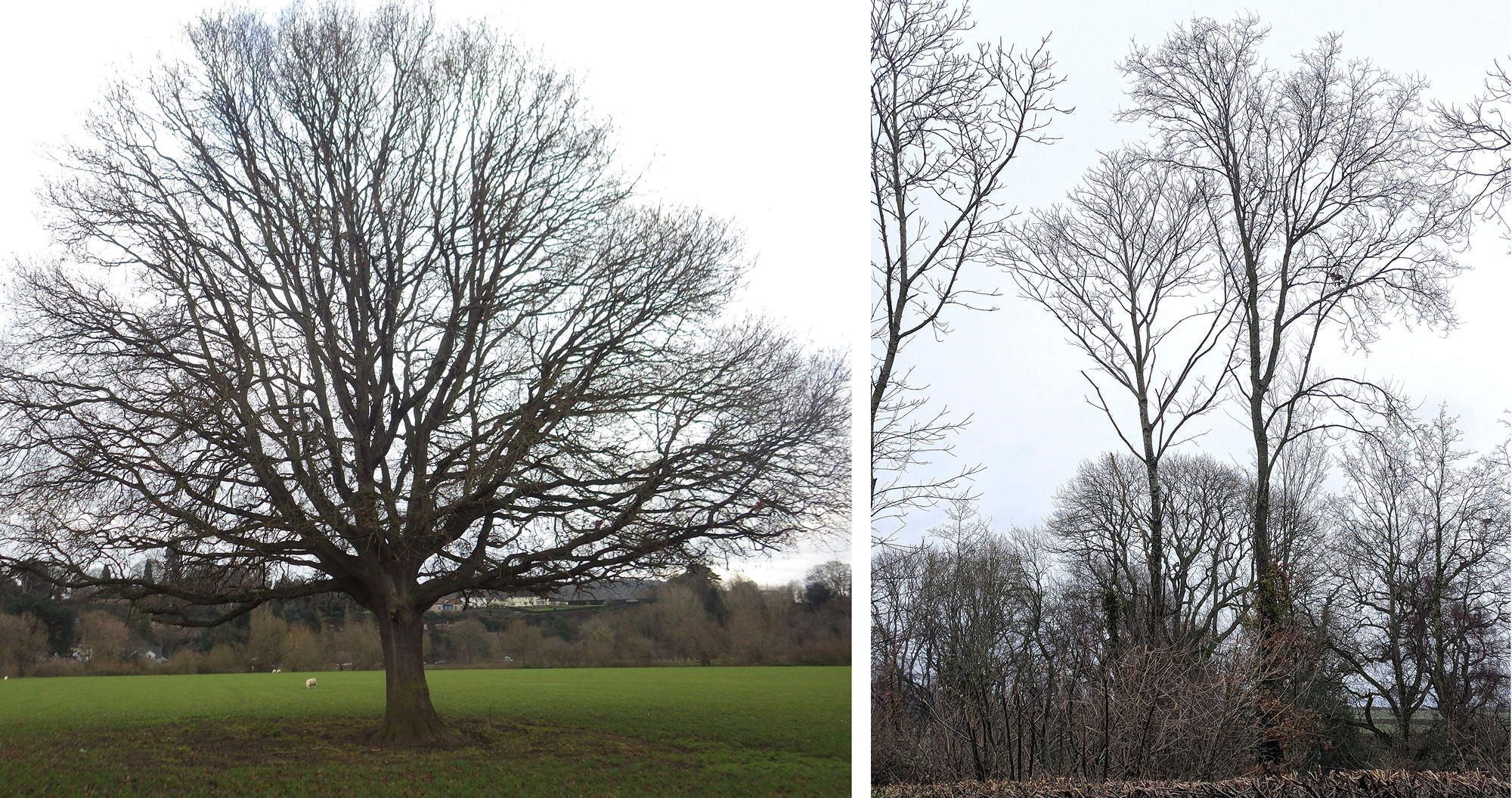
A a single, well developed open-grown tree is likely to be far more productive than a single forest-from tree: it contains a much greater volume of wood, both branch wood and in its extensive root system, and is therefore considerably more effective in sequestering carbon. The larger canopy provides greater opportunities for birds, mammals and invertebrates to feed, shelter and nest, especially as the tree advances in maturity and begins to develop rot-holes and cavities.
Of course it is unrealistic to compare an open-grown tree with a single forest-form one; it would be more realistic to compare the productivity of per unit of land area covered by a block of woodland, as compared to the equivalent area covered by a single open-grown tree. Even then, however, because only the topmost parts of a stand of woodland trees are exposed to sunlight while an open-grown tree is exposed to light on all sides, the overall photosynthetic capacity per unit of ground area will be less in dense woodland than that of an open-grown tree.
None of which is to downplay the importance importance of woodland; both forms have their own characteristic associations with other plants, fungi , invertebrates and other organisms and, to be fair, mature woodland probably supports a greater overall bioversity than does a single, isolated tree. But both forms are of value: the planting and nurturing of open-grown trees should be encouraged quite as much as the establishment of new woodland, not least because there are plenty of opportunities to plant single trees (for instance in hedgerows) where woodland planting is not possible or innappropriate.
These ideas have been explored and expanded by the redoubtable tree expert Ted Green in an article he entitled 'Stating the Obvious':-