About our Trees and Hedges
For information on the woodlands and their history, trees outside woodlands and about hedges, click on the links below.
Trees in Britain
There are estimated to be about 3 billion trees in the UK, although in terms of the number of native species (i.e. those that have been here since the end of the last glaciation and were not introduced by humans) Britain is rather impoverished, with only about 32 species. However a vast number have been introduced since, with more than 3000 having been identified as growing successfully in the British Isles, as listed in the Tree Register of the British Isles. Most of these have been introduced in relatively recent time; the link below provides a list of tree species that existed before 1900, showing the periods when they were believed to have been introduced. Non-native species that have been present since before 1500 are known as Archaeophytes. Some of these may have been brought to these islands by early humans, others by later visitors to these shores, or indeed by invaders such as the the Romans. They brought us walnut and sweet chestnut and possibly sycamore, although some maintain this didn’t come over from its native European range until the Tudor era in the 1500s.
Trees in Herefordshire
According to the Herefordshire Tree, Hedgerow and Woodland Strategy (h-THAWS) the county has an average tree canopy coverage of 19.3%. This is based on National Tree Map data and includes individual and groups of trees as well as woodland. However, the county's woodland cover was estimated in 2021 to be about 12%, slightly more than the average overall cover for England as a whole, which amounts to about about 10% but less than the 13.5% of the UK’s total land area. (Britain is one of the least densely forested countries in Europe, of which some 46% is forested). The County strategy (h_THAWS) aims ot increase the average canopy coverage in the county to 20% by 2041, with an aspiration to reach 30% for Hereford City and the the five market towns.
The county is currently focusing on increasing this cover through its Local Nature Recovery Strategy (LNRS) to boost biodiversity, reduce flood risk, and assist with carbon sequestration, particularly in areas like the Wye Valley and Malvern Hills. Herefordshire is also known for its traditional orchards and one of the priorities set out in the LNRS is PM 13, to 'Restore and enhance Traditional Orchards' which it describes as being
....a pivotal feature in Herefordshire, consisting of groups of fruit trees planted at low-density, and typically traditionally managed with low-intensity methods, such as grazing. Fruit trees include traditional varieties of perry pear, apple, plum and cherry which are grazed to maintain diverse grasslands beneath the trees, such as wood meadows, and allowing light to reach trunks for lichen and invertebrates to thrive. They exist in small and isolated pockets across Herefordshire and can be threatened by lack of sustainable management leading to the collapse of trees from age, excessive mistletoe burden, grazing damage and storms as well as conversion to more profitable land uses, including development. Thus, their management and restoration are key to the ongoing existence of this unique habitat.
Herefordshire is also fortunate in that it is is home to a particulalrly large number of veteran trees; indeed the county is something of a national stronghold for old trees, with the Ancient Tree Inventory highlighting Herefordshire as one, if not the, key area for veteran, ancient, or notable trees.
A project carried out between 2006 and 2009 involved an in-depth study of the county's ancient woodland; a link to the published report, can be found below:
Trees in our Towns
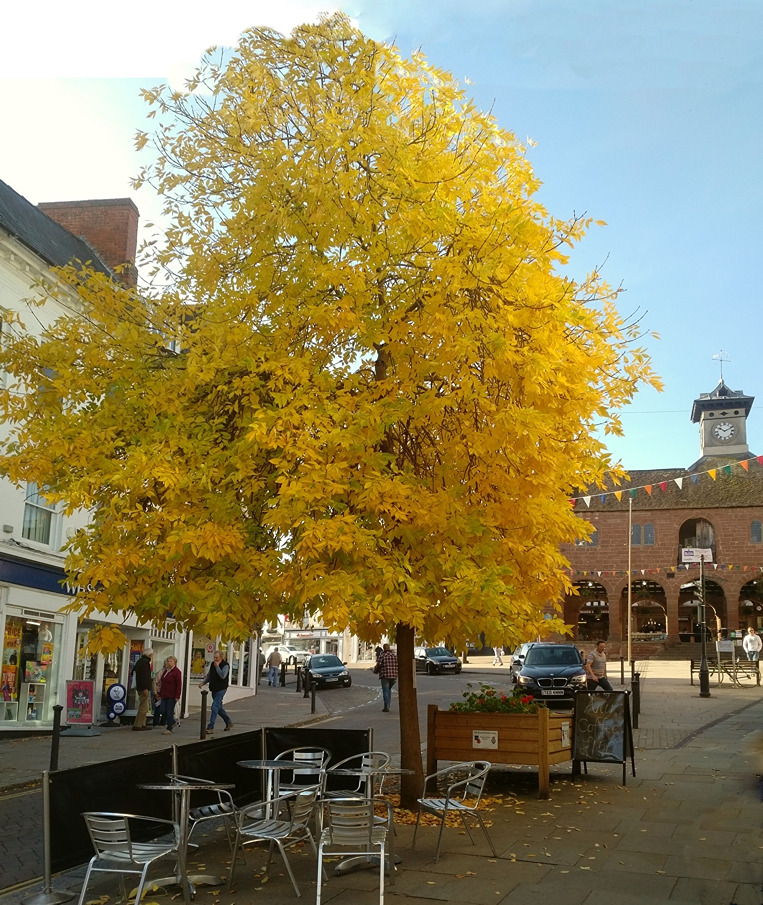
Trees in towns offer a wide range of benefits, making them essential for creating healthier, more livable urban environments, as is discussed in the BENEFITS OF TREES page. Thier vital contributions to the urban environments makes it essential to implement better planning, management, and community involvement in tree care.
While the County of Herefordshire has an essentially rural character, only about 43% of its 193,600 residents (as of 2012) live in truly rural ‘village and dispersed’ areas. About 94,500 live in the four largest settlements (Hereford City, Leominster, Ross and Ledbury) with 6,700 in Bromyard and Kington, plus more in larger villages such as Colwall and Credenhill.
Within these (comparatively) highly populated areas, trees form a vital backdrop and a link between town and country, are source of beauty and interest as well as having crucial environmental and social benefits.
Hereford city has a tree canopy cover of about 15.4%, slightly better than Gloucester (13.6%) and Worcester (14.6%) but not as high as Malvern at 30% and Shrewsbury at 22%..
But efforts have been underway for some time to improve tree cover in the city: back in 2019 a document was produced entitled More Trees for Hereford which provided evidence to inform tree and green infrastructure policies. More recently a consultation was launched to look into the wider tree scape of the county, resulting in the document Herefordshire Tree, Hedgerow and Woodland Strategy (h-THAWS)
This includes following 'Shared Vision for Herefordshire's Treescape':
To create and sustainably manage a thriving network of trees, woodland,
traditional orchards, riparian vegetation, wood pasture & parkland, species-rich
hedges and hedgerow trees across the county. The treescape will connect
across the urban and rural landscapes of Herefordshire, delivering multiple
benefits for people, place and nature – now and into the future.
More Trees for Hereford failed to achieve the improvements in tree cover that it promoted; it is to be hoped that h-THAWS proves to be more successful.
Orchards
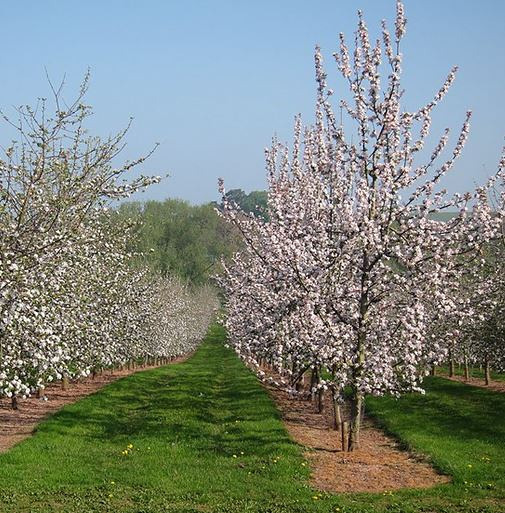
Orchards are special; places to experience and appreciate. Indeed in the seventeenth century John Beale attributed the long lives of Herefordians to"the apple trees purifying the air".
They have long been a way of life in Herefordshire, a treasured part of our landscape and communities, the basis of people's livelihoods and a foundation of the local economy, particularly our cider industry. Back in 1664 the diarist John Evelyn wrote "Herefordshire has become in a manner an entire orchard" and today we still have more than 3,000 orchards, more than any other county in the UK.
In a recent study of six Herefordshire orchards, local nature recording groups found an average of 150 different species in each orchard and the Goldeneye lichen, thought to be extinct in the UK, was recently found in the top of an apple tree. Orchards are also important stores for carbon both in the trees themselves and in the unploughed land beneath them, all the while providing us with food and drink.