A Brief History of British Woodlands:
From Primeval Forests to Managed Landscapes
British woodlands are often imagined as remnants of an ancient, continuous forest that once blanketed the islands after the last Ice Age. While there is truth in this image, the history of Britain’s woodlands is more complex. Over thousands of years, natural processes, climate shifts, grazing animals, and human activity have continually reshaped the landscape. One of the most influential debates in recent decades concerns the structure of prehistoric forests, particularly the theories of Dutch ecologist Frans Vera. Discussed below, his proposals challenge traditional views of dense woodland cover.
Post-Glacial Origins
At the end of the last Ice Age, around 11,700 years ago, Britain began to warm. The glaciers retreated to expose a land scoured of all vegetation but which was soon colonised, first by algae and crustose lichens but then, as soil begins to accumulate, mosses and large lichen species establish themselves, to be followed by shrubs and small trees.
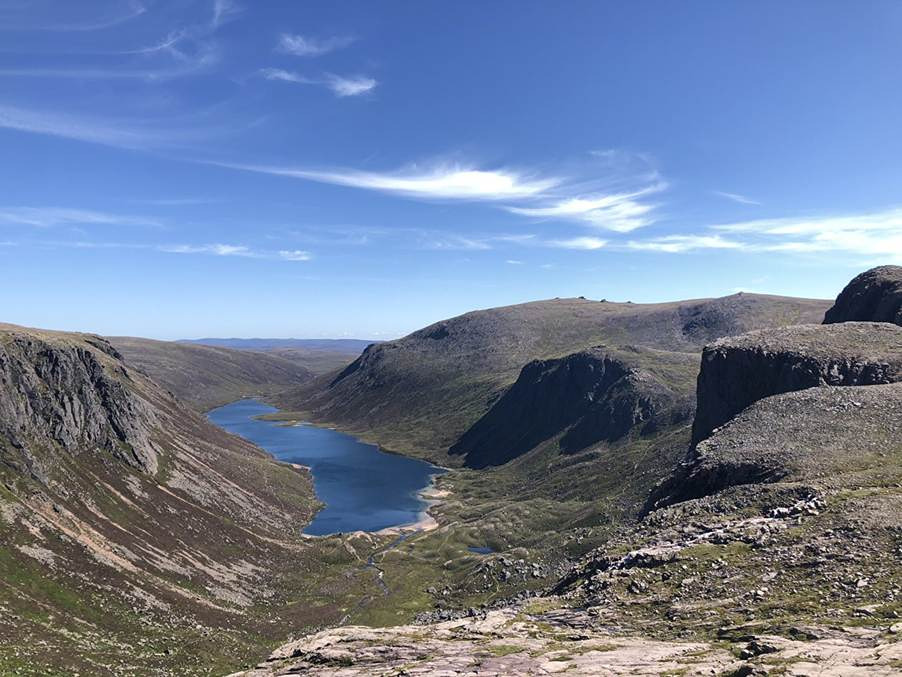
As the climate warmed, trees gradually colonised the landscape from the south-east; pollen analysis (‘palynology’) of peat or other sediments provide us with a detailed, if not entirely complete record of the species that colonised the land over time. The first wooded and forested areas were probably populated with birch, such as Dwarf birch (Betula nana) and B. pubescens (Downy birch). These are typical colonising species that can tolerate the cold conditions and poor soils. They are also wind pollinated, for though the climate was warming it would have been too cold for most pollinating insect species. As time went on and the climate stabilised during the early Holocene period, these early pioneer species were followed by pine, hazel, aspen, elm, oak, and lime until by about 6,000 years ago, much of lowland Britain was covered by what has traditionally been described as “wildwood”: extensive forests dominated by oak, lime, elm, and hazel. These forests were dynamic ecosystems shaped by storms, disease, natural fires, and animals.
The Vera Hypothesis and the Wildwood Debate
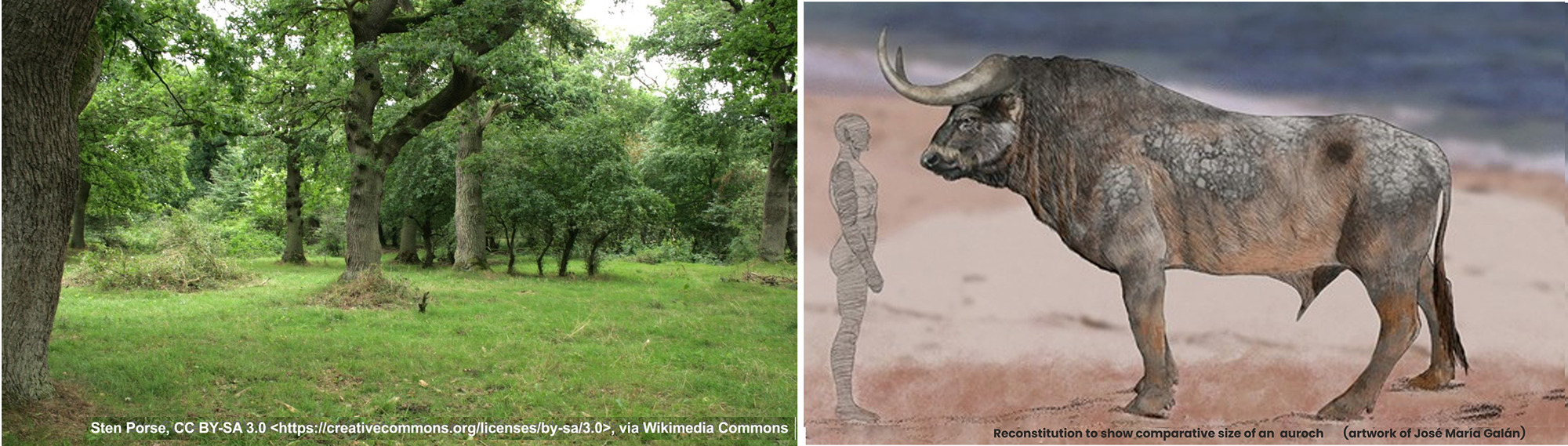
Traditional interpretations of prehistoric European forests assumed that before large-scale human clearance began, dense, closed-canopy woodland dominated the landscape. However, in the late twentieth century, Dutch ecologist Frans Vera proposed an alternative model. Vera argued that prehistoric landscapes were not continuous closed forests but rather mosaics of woodland, scrub, and grassland, forming open wood-pasture, somewhat like that in the image below, on the left. This is European wood meadow in Langå Egeskov, Jutland, Denmark, managed and kept open by controlled grazing by cattle and believed to be similar to pre-existing 'virgin' vegetation. According to Vera's theory, large herbivores such as aurochs (as shown in the drawing below right), wild horses, and deer played a crucial role in maintaining open areas by grazing young trees and preventing full canopy closure. In this “wood-pasture” model, forests would naturally contain glades, grazing lawns, and scattered trees, resembling modern parkland landscapes more than dense forests. Vera suggested that the disappearance of large herbivores such as the aurochs, together with changes in land use, may have altered these natural dynamics.
The Vera hypothesis has sparked considerable debate among ecologists and historians. Critics argue that pollen records and other evidence still support the presence of extensive closed-canopy forests in many parts of Europe. Others see Vera’s ideas as valuable in highlighting the ecological role of grazing animals and disturbance in shaping woodland structure.
The debate has influenced conservation practices, particularly in rewilding projects where large herbivores are introduced to recreate more dynamic woodland ecosystems.
Human Influence in Prehistory
Humans began altering British woodlands long before the historic period. Mesolithic hunter-gatherers used fire to clear small areas, encouraging the growth of plants attractive to game animals. Later, Neolithic farmers began clearing larger areas for crops and livestock.
The spread of agriculture around 4,000–3,000 BCE gradually transformed the landscape. While tree clearance accelerated during the Bronze Age and Iron Age as populations grew and farming expanded, woodland remained essential for the provision of timber, fuel, tools, and construction, with many communities developing forms of woodland management to preserve and encourage this vital resource.
Medieval Woodland Management
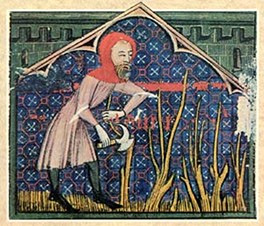
By the medieval period, Britain’s woodlands were highly managed environments. Practices such as coppicing—cutting trees at the base to stimulate regrowth—became widespread with coppicing playing a huge role in the development of our society and its technology. Coppicing has been traced back to as far as Neolithic times (c4000 BC) and by the medieval period it has been estimated that over half of the woodlands in the UK were managed through coppicing .
Coppice provided a sustainable supply of poles, fencing materials, charcoal, and fuel. In many areas, coppice woods were combined with standards, where selected trees were allowed to grow tall to provide large-diameter for timber. As well as providing a range of materials, coppice-with-standard woods also created diverse habitats that supported a wide range of wildlife; many species now associated with “ancient woodland” evolved in these long-managed environments.
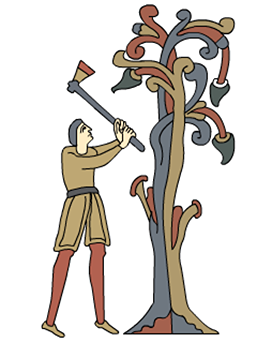
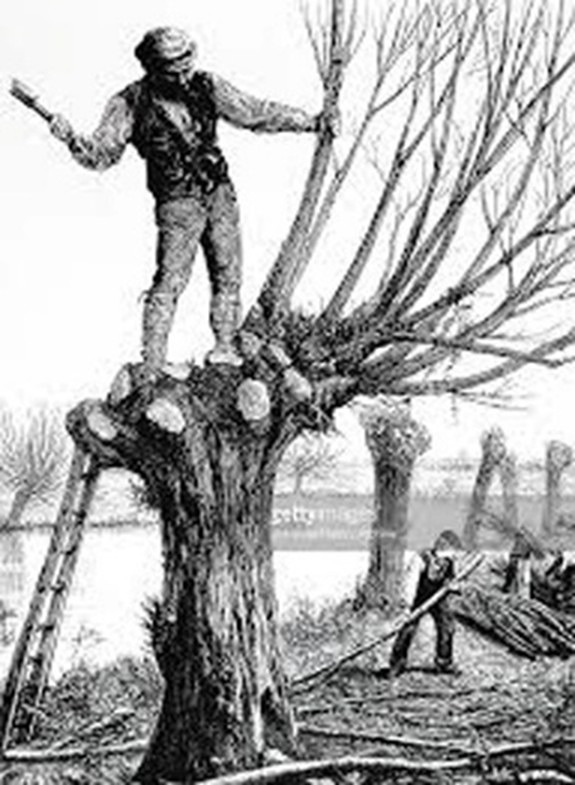
Newly coppiced trees will produce a mass of new growth which would be attractive to browsing animals so that livestock had to be excluded from wooded areas managed in this way. An alternative was to manage trees by ‘pollarding’, cutting the top (or ‘poll’) of the trees at a height that left the young growth out of reach of browsing animals. This was a widespread practice for trees growing within farmed landscapes rather than in woodland and was important in that it provided a valuable source of fodder.
Royal Forests
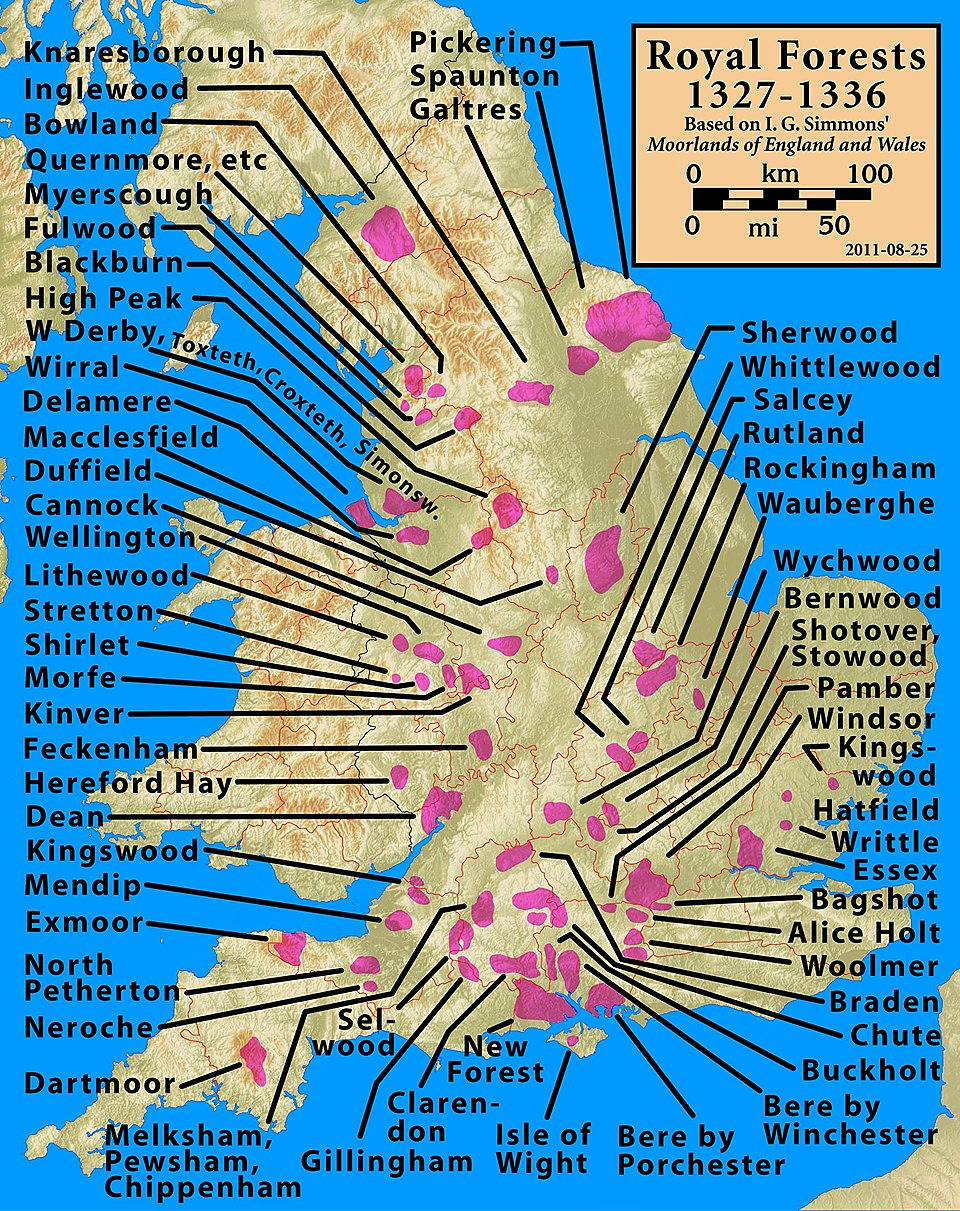
Royal forests became a feature of the English landscape following the Norman Conquest; they were not necessarily heavily wooded but often heath, and scattered trees. At their peak in the late 12th and early 13th centuries, they covered approximately one-third of the land in Southern England, including not just open land but also villages and farmland.
Their main purpose was to preserve game animals such as deer and wild boar for the king and the nobility to hunt. Because of this, strict rules were introduced to protect both the animals and their habitats with forest law; anyone carrying out unauthorised hunting, tree cutting, land clearance or permitting animals to graze in the Royal forests were likely to suffer severe punishment.
With large areas of land being placed under restrictions, peasants and villagers who had traditionally used the land for farming, wood gathering, or grazing found their rights limited, giving rise to resentment. This became so strong that reforms were introduced in the 13th century, notably through the Charter of the Forest in 1217, which reduced the size of royal forests and restored some rights to ordinary people.
Woodland Industry
Woodland industry in early modern times (roughly 1500–1800) was a cornerstone of the economy, providing essential materials for heating, construction, and emerging industrial processes before the widespread adoption of coal; far from destroying forests, early modern industries often protected them through sustainable management practices like coppicing to ensure a continuous supply of wood for a wide variety of purposes. Up to the eighteenth century, woodlands was where much of the industry of Britain occurred, with thousands being employed to harvest and process all the materials derived from the trees.
For hundreds of years, until coal began to take over in the 17th and 18th centuries, smelting for metal production created a huge demand for charcoal, which in turn drove demand for the coppice wood used for its manufacture. (Charcoal was preferred over wood for fuelling early blast furnaces for smelting, as it burns at a higher temperature than wood.)
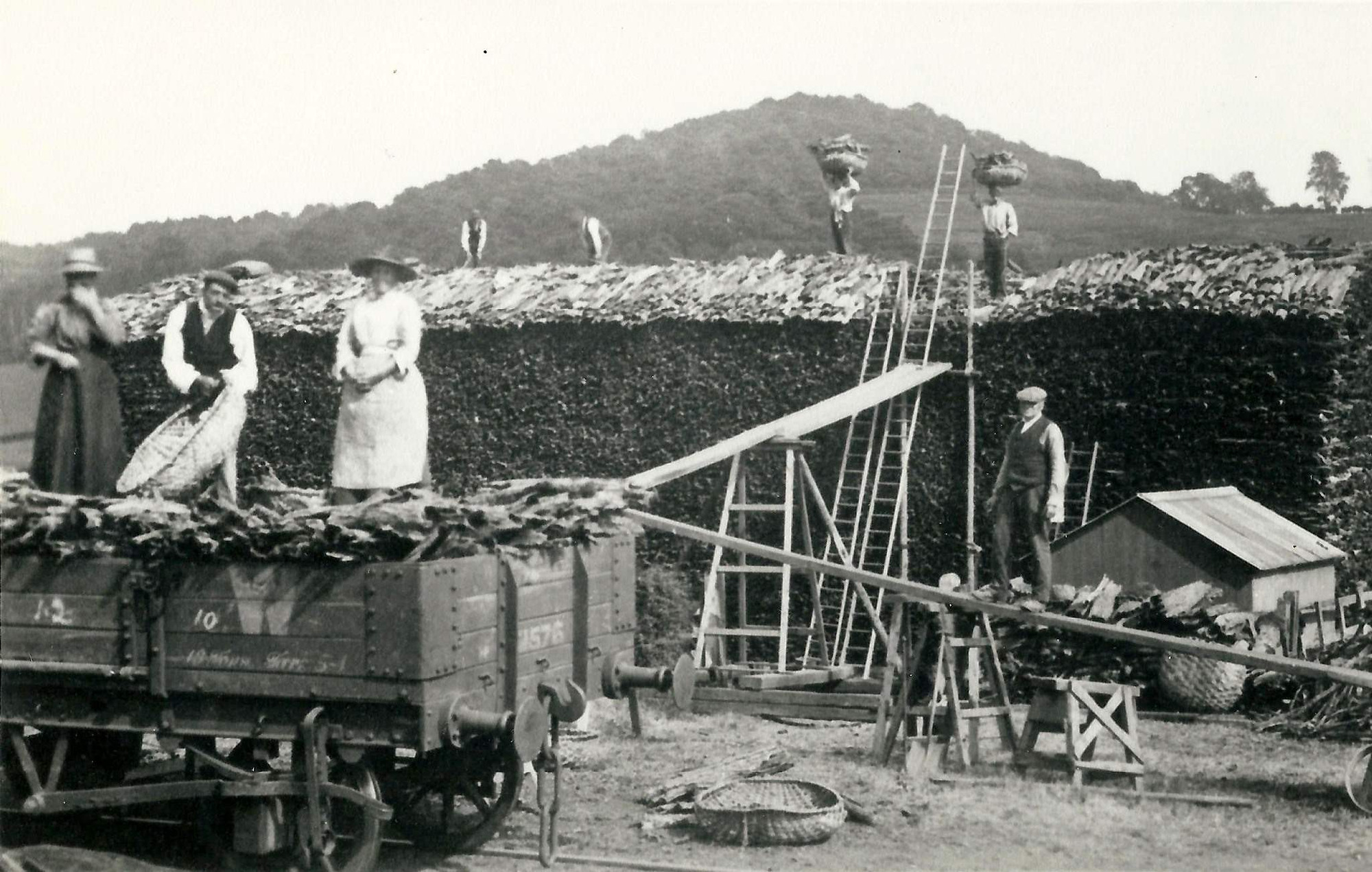
Construction and shipbuilding fed an ongoing demand for timber of larger sizes while oak bark was consumed in large quantities by the tanning industry. Some idea of the scale can be gained from the photo below.
Hazel and oak were used to create barrel hoops, essential for the shipping and manufacturing industries, while charcoal; was also needed to produce the gunpowder used by our armies and the navy. (Alder Buckthorn [Frangula alnus], Willow [Salix spp.] and Alder [Alnus spp.] were favoured for this purpose.)
Decline and Industrial Change
From the early modern period onward, British woodland cover declined significantly. By the 18th century, as demand for energy increased and wood became more scarce in some areas, there was an increasing shift towards using coal as a major energy source, especially in the growing metal industries. However, expanding agriculture, urban growth, and the continuing demands of shipbuilding and industry increased pressure on timber resources until by the eighteenth and nineteenth centuries, woodland covered only a small fraction of Britain.
Twentieth Century Forestry
The Industrial Revolution had brought both woodland losses and also new forms of forestry; while coal reduced reliance on charcoal in some industries, the demand for pit props and construction timber remained high and the First World War further increased demand on the dwindling supplies of timber. As told by Bill Laws in his book Herefordshire’s Home Front in the First World War “Woodlands… were disappearing to feed the demand for everything from pit props to trench works, including and many venerable old trees were put to the axe…” including the St Catherine’s Oak, shown in a photograph below, being hauled by a steam traction engine from The Homend, Stretton Grandison in 1915.
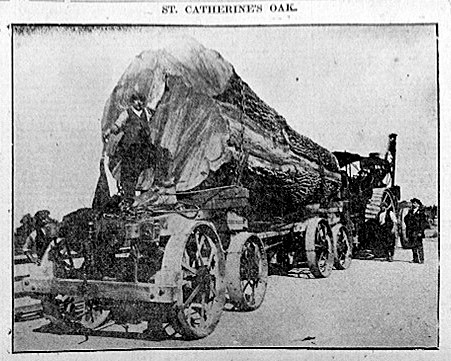
Many trees were indeed felled, to be made 'better use of', such that by the end of the war there was a serious shortage of home-grown timber. This led to the creation of the Forestry Commission in 1919. Large-scale planting programs followed throughout the century, mostly of non-native and fast growing conifers such as North American species Sitka Spruce (Picea sitchensis). The growth of conifer plantations reached a peak in the 1970s and 1980s by which time it is estimated they covered between 1.3 and 1.5 million hectares. These plantations helped rebuild timber supplies but at the cost of many native and ancient woodlands and the transformation of many traditional landscapes. This led to significant criticisms, not least because of the ecological impacts of replacing native species with monocultures of non-native conifers.
In recent decades, forestry policy in Britain has shifted toward restoring native woodland, improving biodiversity, and reconnecting fragmented habitats.
Woodlands today
Today, woodland covers roughly 13 percent of Britain—far less than the European average. However, conservation efforts increasingly focus on expanding native woodland, restoring ancient woodland sites, and improving ecological connectivity.
British woodlands are not simply relics of the past but living landscapes shaped by millennia of interaction between nature and people. Understanding their history—from post-glacial forests to medieval coppices and modern restoration—helps guide decisions about how these ecosystems should be managed in the future